
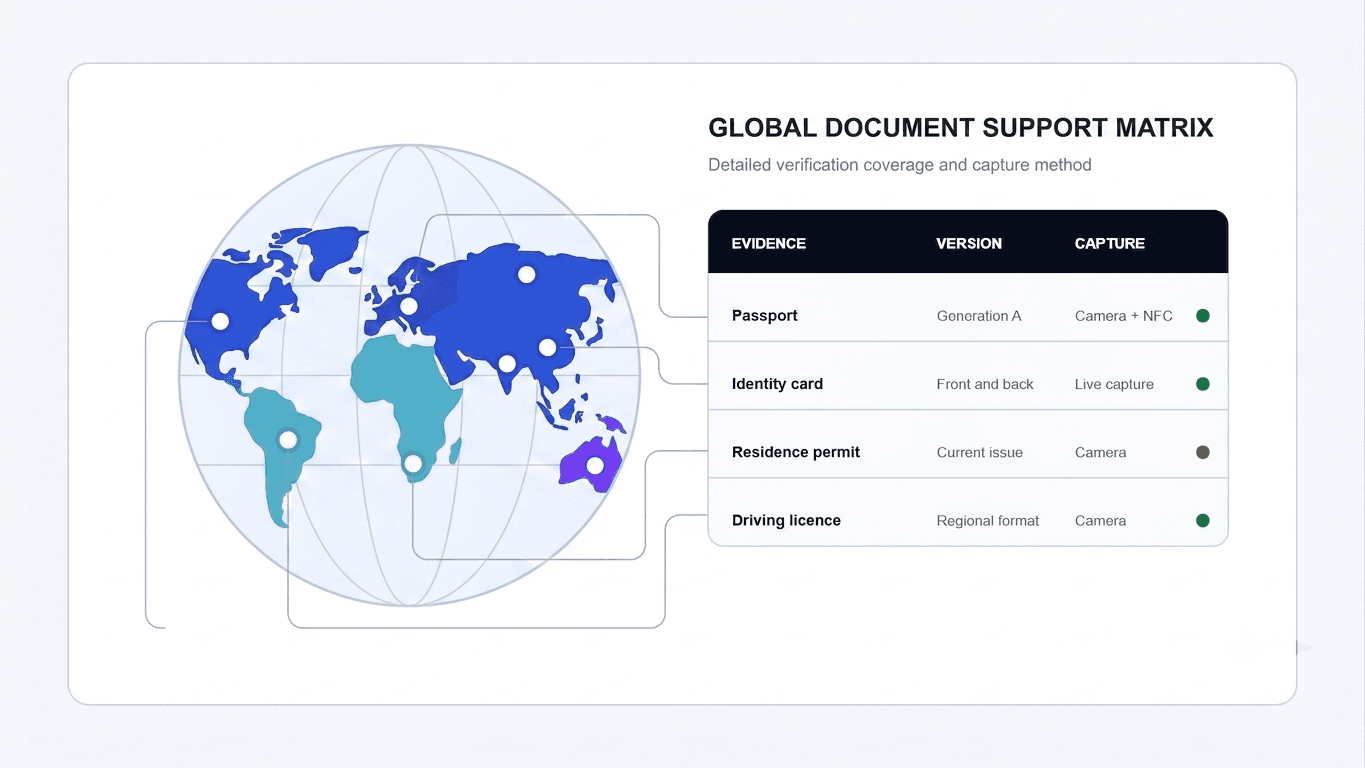
Travel and hospitality businesses serve guests from many countries, but international identity verification cannot be reduced to one global switch.
Two guests may both present passports while using documents with different issuing authorities, security features, document generations, machine-readable zones, NFC capabilities, languages, transliteration rules, expiry conventions, and capture requirements.
A document can be supported in one workflow but unsuitable in another because of capture quality, device limitations, customer policy, or local requirements.
Serious document coverage must therefore be described at the issuing-country, document-type, version, and workflow level.
Why supported in 190 countries is not enough
A broad country number can be useful as an overview, but it does not answer the operator's practical questions.
For example:
- Is the guest's exact passport generation supported?
- Is the identity card accepted?
- Is NFC required or optional?
- Can the document be uploaded, or must it be captured live?
- Are both sides required?
- Which fields can be extracted?
- Can the document support the customer's compliance workflow?
- What happens when the document is damaged?
- Is a residence permit accepted?
- Does the guest need an alternative document?
DocinVault publishes document coverage by issuing country or territory and document type.
The catalog is intentionally described as extensive but not exhaustive because formats, regulatory requirements, capture methods, and product capabilities change.
One country can contain many document types and generations
A single market may issue:
- Multiple passport generations
- National identity cards
- Driving licences
- Temporary residence permits
- Permanent residence permits
- Special identity documents
Older documents may remain legally valid after a newer generation is introduced. Different generations can use different templates, security elements, MRZ formats, chips, and visual layouts.
Coverage therefore needs to identify more than the issuing country.
DocinVault's catalog lists individual document types and versions across Africa, Asia, Europe, North America, South America, and Oceania.
Capture method changes what can be assessed
A document may be collected through:
- Live camera capture
- Controlled upload
- NFC reading
- Assisted video verification
- Manual review
Each method provides different evidence.
A normal image may allow
- Template comparison
- Visible-field extraction
- Expiry checking
- MRZ validation
- Front and back comparison
- Image-quality analysis
NFC may provide
- Chip-derived identity fields
- Electronic document data
- Additional integrity checks
- Comparison between printed and chip information
The strongest available method depends on the document, device, market, and customer workflow.
DocinVault supports camera capture, controlled upload, and NFC-supported collection where configured and available.
Document support is different from universal acceptance
A listed document is not guaranteed to pass every verification.
A session may still require retry or review because of:
- Blur
- Reflection
- Damage
- Cropping
- Unsupported document generation
- Missing document side
- Expiry
- Field inconsistency
- Failed chip reading
- Poor camera quality
- Customer policy
- Local restrictions
This is why DocinVault's coverage document advises customers to confirm support for their actual deployment and not rely only on a general catalog.
Hospitality workflows differ by market
International document coverage is only one part of the deployment.
Operating markets can differ in:
- Required guest attributes
- Accepted document types
- Police or tourism reporting fields
- Retention periods
- Timing requirements
- Access restrictions
- Guest-notice language
- Legal basis
- Biometric conditions
- Manual-review expectations
A property manager serving international guests in Turkey may need a different configuration from an aparthotel operating in Czechia or Poland.
DocinVault therefore configures workflows market by market and does not represent that one setup satisfies every jurisdiction.
The customer defines the purpose and minimum output
Before launch, the customer should define:
- Why identity verification is required
- Which guests must complete it
- Which evidence is accepted
- Which attributes are necessary
- Whether biometric verification is used
- Which users can access results
- How long evidence is retained
- Which system receives the output
- What happens after each status
- Which exceptions require manual review
DocinVault can then configure the session to collect and return the required information.
This is preferable to collecting every available field simply because it exists.
Name handling also matters internationally
International identity data contains practical differences such as:
- Diacritics
- Multiple surnames
- Patronymics
- Transliteration
- Different name order
- Abbreviated booking names
- Missing middle names
- Latin and non-Latin scripts
A booking name may not appear in exactly the same form as the document.
DocinVault's practice statement describes canonical Unicode normalization while retaining diacritics, with an additional stripped variant available for tolerant comparison where names are truncated or incomplete.
The purpose is not to ignore meaningful differences. It is to reduce unnecessary mismatches caused by formatting alone.
A deployment checklist for hospitality operators
Guest markets
Which issuing countries appear most frequently in bookings?
Document mix
Which passports, identity cards, residence permits, and driving licences are commonly presented?
Capture environment
Will guests use mobile browsers, uploads, NFC-capable devices, front-desk equipment, or assisted review?
Operational timing
Must verification happen after booking, before arrival, before check-in, or before door-code release?
Required output
Does the team need only a verified status, selected fields, or data formatted for another system?
Exceptions
What should happen when a guest has an unsupported document or cannot complete the default flow?
Retention
How long should evidence, results, and audit events be retained?
Market obligations
Which local legal or reporting requirements apply?
Coverage should be verified before launch
A responsible provider should not treat its coverage catalog as a permanent guarantee.
Documents change. New document generations are introduced. Older documents expire. Capture methods improve. Regulatory requirements evolve.
DocinVault maintains a published Issuing Countries catalog and asks customers to confirm deployment-specific support before relying on it for production decisions.
This creates a more accurate foundation than a single marketing number.
Frequently asked questions
Practical answers about issuing-country coverage, document versions, capture methods, and deployment-specific checks.
Continue the conversation
Confirm document coverage for your guest markets
Tell us where your properties operate and which issuing countries your guests commonly use. The DocinVault team can help confirm the documents, capture methods, and workflow configuration relevant to your deployment.
contact@docinvault.com